
Online roulette is one of the most popular casino games across the world, including the United Kingdom, Ireland, Canada and South Africa. It follows the same principles as traditional roulette found in physical casinos, but it is completely digital and can be played from any device. Players place bets on numbers, colours or combinations and wait for the result of each spin, which is determined by a fair and secure electronic system.
In online roulette, outcomes are controlled by an algorithm known as the RNG (Random Number Generator), which produces independent and random results for every round. This ensures that no manipulation occurs, providing a transparent and reliable gaming experience regardless of where you play.
The most common versions are European roulette and American roulette. The main difference lies in the additional “00” pocket on the American wheel, which slightly changes the odds and increases the house edge. Understanding these differences helps players choose the version that best suits their strategy and playing style.
SpinAtaque analyses number sequences in real time, detecting mathematical patterns and variations within the game. Using data-based and statistical models, the system offers intelligent online roulette strategies without interference from casinos, APIs or external software. This enables players to make more informed decisions and maintain greater control during each session.
For anyone who wants to understand how online roulette works and improve their analytical approach, SpinAtaque provides an independent, reliable and accurate tool. Whether you play online roulette in the UK, Canada or South Africa, the platform offers a complete analytical experience that makes the game more strategic and transparent.
In essence, online roulette combines luck, probability and strategy. With the help of systems like SpinAtaque, players can interpret real data patterns and transform the way they experience roulette—making the game smarter and more insightful.
Tradiciona roulette
Roulette is one of the most traditional games, its origin dates back to the 17th century. In the beginning it was more popular among European high society, but soon it spread throughout Europe and reached the Americas where it suffered adaptations and thus were created, variants of this game that even today enchants its adepts.
In general, a roulette table is composed of a WHEEL divided into houses and each house represents a number. Depending on the model, a roulette wheel can contain between 12 and 38 numbers. The most common is the European roulette wheel consisting of 37 numbers ranging from ZERO to THIRTY SIX.
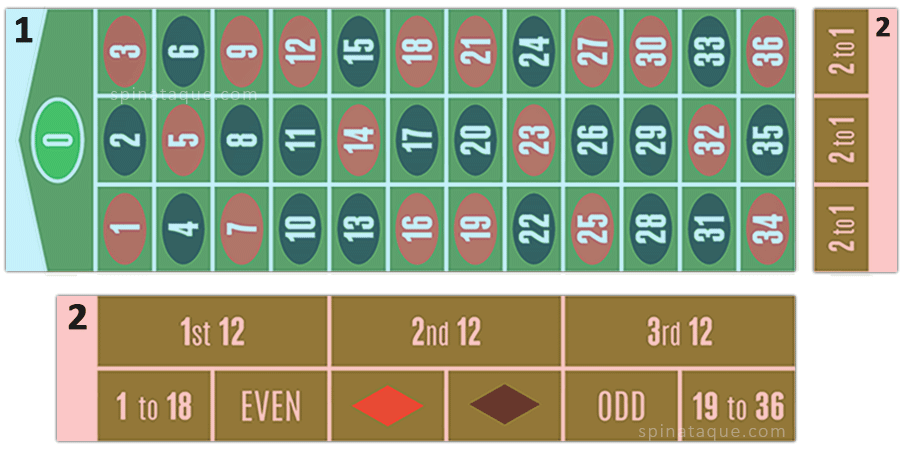
A roulette wheel also accompanies its table or board where players place their bets. This table has the same numbers as the ROUTE, and are arranged in such a way as to allow a player to indicate to the CRUPIER, (the person responsible for spinning the roulette wheel and managing the bets.), where he wants to bet and how much.
Once the bets are placed, the Dealer spins the roulette wheel normally clockwise and throws a small ball inside the roulette wheel and in the opposite direction that the roulette wheel was spun. He waits for the ball to settle, between a square of the houses with its numerical representation.
In the end, the winner is that bettor who matched his bet with the number corresponding to the one drawn on the roulette wheel.
Bets can be made in various ways and each of them, pays a specific amount, prize. A bet can consist of one or more numbers and its principle quite simple to understand, the fewer numbers a play has, the more it pays the bettor. Each roll has a name and a rule, as well as a prize. Depending on the roulette model, the plays and prizes may vary.
Basically a roulette table is divided into two areas an outer area where bets that pay less are made and an inner area where bets that pay higher prizes are made.
Attention must be paid to the limits of the table. A table can have a maximum bet limit per player and a maximum bet limit per type of play. This varies from casino to casino and table to table.
See below an example of possible moves and values for a European-type roulette table.
| Name of the Play | Composed by | Pay |
|---|---|---|
| External Area: | ||
| Low numbers, (1 to 18). | 18 numbers | x2 |
| Even numbers, (Even). | 18 numbers | x2 |
| Red numbers, (Red). | 18 numbers | x2 |
| Black numbers, (Black). | 18 numbers | x2 |
| Odd numbers, (Odd). | 18 numbers | x2 |
| High numbers, (19 to 36). | 18 numbers | x2 |
| 1st, 2nd and 3rd Dozen, (1st 12, 2nd 12, 3rd 12). | 12 numbers | x3 |
| 1st, 2nd and 3rd Column, (2 to 1). | 12 numbers | x3 |
| Internal Area: | ||
| Double Row. | 6 numbers | x6 |
| Square, Corner or Street | 4 numbers | x9 |
| Trio. | 3 numbers | x12 |
| Split. | 2 numbers | x18 |
| Full Number. | 1 number | x36 |